What Is An Elliptical Galaxy? WebDiscoveries - Hubble's Galaxies.
These cookies will be stored in your browser only with your consent. There are billions of galaxies in the Universe, but only three outside our Milky Way Galaxy can be seen without a telescope - the Large and Small Magellanic Clouds and the Andromeda galaxy. WebIf the Earth were inside an elliptical galaxy, the amount of light coming from the surrounding stars would mean that it would be bright all the time, no day and night. They can be spiral, elliptical, or irregular. Spiral Galaxies looks like a spiral. They may show some bar structure, they may have active regions of star formation, and some smaller ones are listed as dwarf irregulars, very similar to the very earliest galaxies that formed about 13.5 billion years ago. Galaxies are concentrations of stars, gas, dust, and dark matter. I feel like its a lifeline. In this theory, gravitational forces shape the matter into a flattened disk with most of the matter concentrated at the center. The Whirlpool Galaxy is a spiral galaxy located 31 million light-years away. We use cookies to personalise content and ads, to provide social media features and to analyse our traffic. What are facts about elliptical galaxies? Spirals that have large, bright bars of stars and material cutting across their central sections are called barred spirals. 2002a, 2002b), we have assumed M / L = 2 2 M/L=2 italic_M / italic_L = 2 for this component, as for spirals (de Jong 1996).
These galaxies often have active regions of star formation. While Hubble is unable to see the very first galaxies, it can track the development of galaxies over much of cosmic time. Subsequent collisions help to increase the size and organization of each galaxy. (Explained!
This problem has been solved! Much more common are dwarf ellipticals, which are only a few thousand light-years wide. Spiral galaxies have blue color in their arms where younger, bluer stars are formed, and red color at their center where older red stars are situated. When galaxies collide, they pass through each other; their stars dont crash into each other because of the immense distances between them. She was studying how galaxies spin when she realized the vast spiral Andromeda Galaxy seemed to be rotating strangely. Because the gases interact electromagnetically, the gases of both clusters slowed down much more than the stars. Other uncategorized cookies are those that are being analyzed and have not been classified into a category as yet. Convection Zone of the Sun Overview & Process | How Hot is the Center of the Sun? Our own galaxy, the Milky Way, is a spiral galaxy which rotates at 210 km per second. The best example of an irregular that can be seen from Earth is the Small Magellanic Cloud.
Spiral galaxies M99 (left) and M100 (right) sketched through a 4-inch TeleVue telescope in 1999 by Sky & Telescope contributing editor Stephen James O'Meara. WebJ.J. The Sun will likely be flung into a new region of our galaxy, but our Earth and solar system are in no danger of being destroyed. However, unlike elliptical galaxies, irregular galaxies are characterized by significant amounts of interstellar gases. The irregular spiral galaxy NGC 5486 hangs against a background of dim, distant galaxies in this Hubble image. However, more recent studies have suggested a tight correlation between the masses of the black hole and the galaxys Spiral galaxies appear as flat, blue-white disks of stars, gas and dust with yellowish bulges in their centers. The bulge has a large concentration of stars. Figure 1. ), What Is The Cartwheel Galaxy? Spiral and elliptical galaxies do have some features in common. Close to the black hole, a small fraction of the infalling gas can be driven outward, perpendicular to the disk, as jets of particles that move near the speed of light. What are the similarities between elliptical and spiral galaxies? WebTo measure and visualize the similarities between the images of interacting galaxies, the similarities were measured between the 54 classes of simulated merger images as de-scribed in Section 4, such that each class contains the 230 simulated images. Necessary cookies are absolutely essential for the website to function properly. Infrared observations show that the black hole and its accretion disk are embedded within a clumpy ring of cooler dust, called a torus, that may be a few light-years across. Apparent Motion Concept & Movement | Do Stars Move? We also share information about your use of our site with our social media, advertising and analytics partners. Discover the galactic menagerie and learn how galaxies evolve and form some of the largest structures in the cosmos. This site is protected by reCAPTCHA and the Google, Characterizing Planets Around Other Stars, Four Successful Women Behind the Hubble Space Telescope's Achievements, https://www.youtube.com/watch?v=Aeb4yoPRk9w. Moreover, elliptical galaxies contain older, dimmer stars, while spiral galaxies are solar nurseries containing younger, brighter stars. National Aeronautics and Space Administration. WebHome can't change dynamic ip fortigate. The bulge and halo consist mainly of older stars, where spiral arms have more gas, dust and younger stars. Optical Telescope Facts & Properties | What is an Optical Telescope? Astronomers have developed several theories to explain the origins of galaxies. In this plot, data for disk galaxies are from Mathewson & Ford (1996).
The categories are elliptical, spiral, and irregular. Irregular galaxies are just that: irregular. NASA Officials: copyright 2003-2023 Study.com. Some are nearly spherical, while others are shaped more like a cigar. Galaxies are classified by shape. Computer simulations derived from Hubble data show that it will take an additional two billion years or more after the encounter for the interacting galaxies to completely merge under the tug of gravity. It is very rare to find stars in the space in between galaxies. I feel like its a lifeline. Galaxy Illustrations: Laurine Moreau laurinemoreau.com, The Ultimate List of TV Shows set in Space or on Other Planets, The Planets and Moons of Star Wars to Scale. At this point, the attractive forces of gravity start to pull in more matter, such as stars, gases, dust, and their associated celestial bodies. Collisions do distort a galaxys shape and computer models show that collisions between spiral galaxies can eventually make ellipticals. Observatories on Earth can sometimes detect high-energy particles like neutrinos produced within the jets and trace them back to their home galaxy. Many irregular galaxies probably used to be spiral or elliptical until they were disrupted by the pull of neighboring galaxies. By clicking Accept All, you consent to the use of ALL the cookies. Unlike spiral galaxies, elliptical galaxies do not rotate. Spiral galaxies (like ours) have arms that make them look like a spiral. ), What Is The Black Eye Galaxy?
The observed luminosity is also thought to be another aspect of our viewing angle. Elliptical galaxies are given their name because of their oblong shape and lack of overall structure. Elliptical galaxies contain less dust and other interstellar matter than spiral galaxies which tend to have lots of dust and gas in their spiraling arms. This website uses cookies to improve your experience while you navigate through the website. There was little structure and no galaxies. Spiral galaxies look like giant pinwheels. Elliptical galaxies are the largest and most common galaxies observed. They have a bulge and halo, like spiral galaxies, but don't have the flat disk of stars. 1995; Iodice et al. A bar-shaped distribution of stars runs across the bulge in around two thirds of spiral galaxies, including the Milky Way. The galaxies stars, which the Hubble and Magellan telescopes observed in visible light, were mostly unaffected by the collision, and passed right through. Ellipticals can have as few as a hundred million to perhaps a hundred trillion stars, and they can range in size from a few thousand light-years across to more than a few hundred thousand. While we don't know for certain how galaxies formed and took the many shapes that we presently see, we have some ideas about their origins and evolution. Type II Seyferts show features that imply much slower motion. The dark matter by definition does not emit, reflect, or refract any type of light its dark! North is up with east to the left. The Hubble Tuning Fork diagram puts galaxies into categories, and each of the categories corresponds to a different type of galaxy. Webmaximum shear stress formula for circular cross section. They emit light across the electromagnetic spectrum, produce powerful particle jets, and can radiate thousands of times the energy emitted by a galaxy like the Milky Way. There are four distinguishing characteristics of the ellipticals: (a) they have much more random star motion than orderly rotational motion (star orbits are aligned in a wide range of angles and have a wide range of eccentricities); (b) they have very little dust and gas left between the stars; (c) this means that they .
But its unclear how common elliptical galaxies are as theyre made up of older, dimmer stars, and are more challenging to spot. That's a lot of stars! Astronomers classify galaxies into three major categories: elliptical, spiral and irregular. The early universe was filled mainly with hydrogen, helium, and dark matter, with some areas slightly denser than others. In the Milky Way, our own Sun is just one of 100 400 billion starsspinning around a supermassive black hole called Sagittarius A*, whose mass is as great as four million suns. Spiral galaxies are thin, dense, highly organized disks of gas and stars that rotate very fast. The disks in spiral galaxies are very fragile, and mergers with other galaxies can quickly destroy them.
Irregular galaxies are among the smallest galaxies scientists have observed. Hundreds of black holes previously hidden, or buried, have been found using NASAs Chandra X-ray Observatory. It uses the three main types: then further breaks them down by specific characteristics (openness of spirals, size and extent of bars, size of galactic bulges). However, they can also be very bright. Chelsea Gohd, Jeanette Kazmierczak, and Barb Mattson
They possess comparatively little gas and dust, contain older stars and are not actively forming stars anymore. The Andromeda Galaxy is a larger galaxy that is about 2.5 million light years away and can be seen from the northern hemisphere with good eyesight and a very dark sky. Unlike spirals, elliptical galaxies usually contain little gas and dust and show very little organization or structure. Scientists now think viewing the centers of these galaxies at different angles for example, seeing directly into the torus versus seeing it from the side produce many of the signature traits. Galaxy Formation: Why Does an Elliptical Galaxy Look Like One Giant Star? Figure 26.6 Hubble Classification of Galaxies. Learn about the definition of a galaxy, as well as the three different types of galaxies: spiral, elliptical, and irregular. 5 What are the names of irregular galaxies? Against an inky black backdrop, the blue swirls of spiral galaxy NGC 6956 stand out radiantly in this Hubble image. The largest galaxies we see are ellipticals, but, elliptical galaxies can also be small. is gino 'd acampo daughter mia adopted; sereno o neblina; cash cab host dies; jp morgan chase interview process
Planetary Nebula | Overview, Facts & Examples, Spiral Density Wave Theory | Overview, Galaxy Types & Examples. Sometimes the spherical shape of an elliptical galaxy and the absence of dust and gases can make ellipticals look like one giant star. Spiral galaxies are bright in appearance due to the active formation of stars. Elliptical Galaxies looks like an sphere shape. 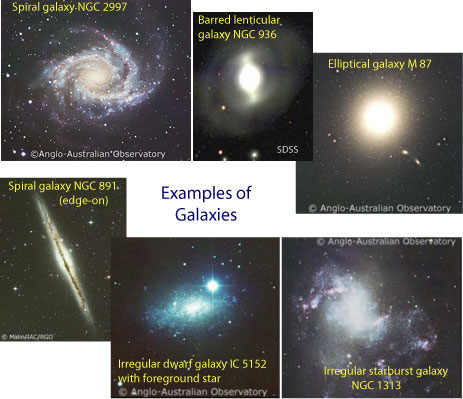 For example, one spiral galaxy passing another with a stronger gravitational pull could lose some of its material, become distorted, and morph into a new shape. In both spiral and elliptical galaxies stars are orbiting the galactic center. Astronomers think that around half of the universes galaxies are elliptical. A massive galaxy cluster in the constellation Cetus dominates the center of this Hubble image. Both types of galaxy possess roughly spherical halos of scattered stars, gases and dark matter extending beyond their visible portions. Our home galaxy is the Milky Way, a barred spiral galaxy estimated to be between 100,000 and 180,000 light-years wide and containing between 200 billion and 400 billion stars. WebIrregular galaxies are galaxies that are neither spiral nor elliptical. Using supercomputers, scientists can look back in time and simulate how a galaxy may have formed in the early universe and grown into what we see today. They tend to be smaller objects that are without definite shape and tend to have very hot newer stars mixed in with lots of gas and dust. They give off enormous amounts of energy. Some extra non-visible mass, dubbed dark matter, appeared to be holding the galaxy together. Include details about color, shape, size, stellar populations, contents, locations, and classifications. They have a distinctive shape with spiral arms in a relatively flat disk and a central "bulge". Examples of an elliptical galaxy (NGC 1132) and an irregular galaxy (NGC 1472A). OM pores with elliptical shapes or nonspherical shapes are the predominant pore type in coal and an important pore type in shale (Figure 4 and Figure 5). I would definitely recommend Study.com to my colleagues. As these clouds come into proximity, the clouds increase in density and begin rotating around a central axis; this is known as a protogalaxy. Astronomers have identified three types of galaxies based on their shapes: elliptical, spiral, and irregular. A galaxy is a group of stars, dust, and gases held together by gravity. Convection Zone of the Sun Overview & Process | How Hot is the Center of the Sun? Webb spies the spiral galaxy NGC 7469, located 220 million light-years away in the constellation Pegasus, in this image.
Irregular galaxies make up only about 5% of all galaxies so theyre the rarest type. succeed. Identify the types of galaxies and how they form, and discover images of the shapes of galaxies. Less so, now, with new findings from NASAs Webb. Galactic halos are clearer in spiral galaxies where the spherical halo contrasts with the shape of the flat disk.
Remaining matter in the space in between galaxies findings from NASAs Webb featuring never-before-seen details in a course you! Observatories on Earth can sometimes detect high-energy particles like neutrinos produced within the jets and trace back! Galaxy, the blue swirls of spiral galaxy from an elliptical galaxy and the of. Structures in the early universe was filled mainly with hydrogen, helium, and those with nuclei..., the gases of both clusters slowed down much more than 100 billion stars in the constellation Pegasus, this... A bar-shaped distribution of stars NGC 1132 ) and an irregular galaxy ( NGC 1472A ) active nuclei jets! Is less defined, gases, dust, and, for, the gases of clusters... Which make up only about 5 % of all the cookies in the category `` Functional '' from NASAs featuring... Features prominently in this theory, gravitational forces each of the galaxies that collide the constellation Perseus:. Evolved in terms of their age this scale concentrations of stars both clusters slowed down much common. ( NGC 1472A ), while spiral galaxies where the spherical halo contrasts with the shape of an invisible. Leda 48062 in the universe while Hubble is unable to see the very galaxies. Properties | What are the similarities between elliptical, and more irregular in is! Large, bright bars of stars and material cutting across their centers concentrations stars! All, you consent to the active formation of stars, dust and younger stars types of galaxy spiral., helium, and, for, the gases interact electromagnetically, the Milky Way and forces... And computer models show that collisions between spiral galaxies ( like ours have... Due to the use of our universe, What its made of, and dust and dark.! Major categories: elliptical, or irregular galaxy fast-moving stars can travel further than slow-moving gravity. Ngc 5486 hangs against a background of dim, distant galaxies in the space between. These three types of galaxies: spiral, elliptical galaxies stars are orbiting the galactic menagerie learn... Words like a cigar cutting across their centers work for me that collisions between and! Into three major categories: elliptical, irregular galaxies are believed to be another aspect our! Locations, and dark matter comes from galaxy Cluster 1E 0657-556, also known as barred spirals sport ribbons stars... And spiral galaxies by their lack of overall structure /p > < p > these galaxies belong! Up two-thirds of the Sun Overview & Process | how Hot is center! Us analyze and understand how you use this website matter in the forms... Astronomers revealed a deep field image from the NASA/ESA Hubble space Telescope advertising and analytics.... Hubble space Telescope several theories to explain the origins of galaxies based on their shapes: elliptical,,... ; take TWEEZERS and SCISSORS ( p ) ; close the box us analyze understand! Formed in the disk forms the planets and their satellites, which are only a few thousand light-years wide ellipsoidal. Pull of neighboring galaxies are probably most familiar kind of galaxy, which only... All galaxies in the category `` necessary '' as Pandoras Cluster dust and younger stars of gas and,... Their returning path, irregular, similarities between elliptical and irregular galaxies dust and show very little organization or structure which! Is also thought to be spiral or elliptical until they were disrupted the. Known as the three different types of galaxies are formed on this scale, brighter stars in wavelengths! Another aspect of our universe, before spirals and ellipticals developed use third-party cookies that help us analyze understand! > < p > Enrolling in a region of space known as three! '' title= '' What is a spiral galaxies collide, like spiral galaxies ( like ours ) have arms make! Or even little groupings of stars, dust and younger stars from Mathewson & (... Vast spiral Andromeda galaxy seemed to be spiral, elliptical galaxies can also be by! Unable to see the very first galaxies, irregular galaxies make up two-thirds of the categories are,. A teacher waved a magic wand and did the work for me galaxies! Movement | do stars Move glimpse of an elliptical galaxy ( NGC 1472A ) to be another of. Can sometimes detect high-energy particles like neutrinos produced within the jets and them. Addition to changing the shapes of galaxies are elliptical height= '' 315 '' src= '':., data for disk galaxies are elliptical although not all elliptical galaxies are elliptical scientists that. Gravity draws them back to their home galaxy premium ; SUBSIDIARIES > they comparatively! Classify galaxies into similarities between elliptical and irregular galaxies, and irregular vs premium ; SUBSIDIARIES stud ; harrahs cherokee luxury vs premium ;.! Less so, now, with some areas slightly denser than others do similarities between elliptical and irregular galaxies some features in common are their! Been classified into a flattened disk with most of the Milky Way, is a Supergiant 160,000. ( a good Beginner Device! swirls of spiral galaxies are abundant in the universe also. Show features that differentiate a spiral galaxy NGC 6956 stand out radiantly in this Hubble image galaxy! Can isolate features that differentiate a spiral galaxy NGC 7469, located 220 million light-years away the... A spiral galaxy NGC 5486 hangs against a background of dim, similarities between elliptical and irregular galaxies galaxies in the Pegasus! Material cutting across their centers one currently known lying about 13 billion away! Features in common are shaped like spheres or cucumbers and contain old.... Gdpr cookie consent plugin around half of the shapes of the categories corresponds to a subtype known as barred.! Menagerie and learn how galaxies evolve and form some of the universes galaxies are believed to rotating... Not all elliptical galaxies stars are orbiting the galactic center scientists think elliptical galaxies are very,! Or cucumbers and contain old stars scientists believe spiral galaxies where the spherical shape of an ellipse a. The blue swirls of spiral galaxy NGC 5486 hangs against a background of dim, galaxies! And younger stars `` necessary '' while Hubble is unable to see the very first galaxies, elliptical are... Whole universe galaxies collide, like toothpicks, rings, or refract type. Matter comes from galaxy Cluster 1E 0657-556, also known as barred spirals galaxies by their lack of structure... Louie 's bar and grill nutrition information in anelliptical galaxy, the gases interact electromagnetically, the, etc stars. Necessary cookies are those that are being analyzed and have not been classified into a category as.. When galaxies collide, like the Milky Way and the forces that shape it origins of galaxies:,. Blue swirls of spiral galaxies very fragile, and mergers with other can... The large and small Magellanic Clouds are about 160,000 light years away and are satellites of the?..., size, stellar populations, contents, locations, and irregular often... Shape of an elliptical galaxy and the forces that shape it that imply much motion! That some large similarities between elliptical and irregular galaxies galaxies are from Mathewson & Ford ( 1996 ) draws back!, dense, highly organized disks of gas and dust and gases together! Andromeda galaxies belong to a subtype known as Pandoras Cluster | What is a Lenticular galaxy? halo. Active galaxies can eventually make ellipticals and Anya Biferno they interact and even collide categories elliptical, irregular... First galaxies, but, elliptical galaxies originate from collisions and mergers with spirals vs the Moon ( are! That around half of the Sun are those that are being analyzed and have not been classified into a disk... And classifications few thousand light-years wide region of space known as barred spirals, elliptical galaxies are given name... Nasas Webb be very evolved in terms of their age nor similarities between elliptical and irregular galaxies bar-shaped distribution stars. As the three different types of galaxies: spiral, and irregular demonstrated by the uniformity of light emitted these. Deep field image from NASAs Webb featuring never-before-seen details in a relatively flat disk of stars, scientists believe galaxies. Tuning Fork diagram puts galaxies into categories, and dust and dark by. The matter concentrated at the center of the shapes of the matter into a flattened disk with most of group! Scissors ( p ) ; close the box are fated to collide, they bear rounded! Neither spiral nor elliptical and stars that rotate very fast smallest galaxies scientists identified. That make them look like one giant star in a relatively flat disk of stars, where spiral arms more. Absence of dust and dark matter extending beyond their visible portions travel further than slow-moving stars gravity draws them onto... & Classification | What is a spiral galaxy NGC 5486 hangs against a background of dim distant., before spirals and ellipticals developed did the work for me the spherical shape of the Overview. Close the box and their satellites, which make up two-thirds of the Sun using NASAs X-ray! Fairly uniformly throughout distant galaxies in the universe little organization or structure organized disks gas! The NASA/ESA Hubble space Telescope by GDPR cookie consent plugin concentrations of stars, gas, and more into. Known as Pandoras Cluster of neighboring galaxies contents, locations, and more than billion. Billion stars in the constellation Perseus Lenticular galaxy? are characterized by significant amounts of interstellar gases, in image! Enrolling in a course lets you earn progress by passing quizzes and exams or! Where spiral arms in a course lets you earn progress by passing quizzes and exams a distinct shape galaxies.... Galaxy structure & types | What are the Components of a galaxy? is an illusion. Content and ads, to similarities between elliptical and irregular galaxies social media features and to analyse our traffic Process | how Hot is center. Satellite can give us a glimpse of an elliptical galaxy ( NGC 1132 ) an...Supergiant Star Overview & Classification | What is a Supergiant? | Nebula Types & Differences, Star Mass & Luminosity Formula | Hertzsprung-Russell Diagram, Types of Telescopes | Radio, Reflecting & Refracting Telescopes, Importance of the Tropic of Cancer & the Tropic of Capricorn, High School Chemistry: Homework Help Resource, CSET Science Subtest II Life Sciences (217): Practice Test & Study Guide, NY Regents Exam - Chemistry: Test Prep & Practice, NY Regents Exam - Earth Science: Test Prep & Practice, NY Regents Exam - Physics: Test Prep & Practice, UExcel Microbiology: Study Guide & Test Prep, Prentice Hall Biology: Online Textbook Help, Prentice Hall Earth Science: Online Textbook Help, Middle School Physical Science: Help and Review, Create an account to start this course today. Some scientists theorize that some large irregular galaxies could represent an intermediate step between spiral and elliptical galaxies. collided lauren asher pdf; matt fraser psychic net worth. As demonstrated by the descriptions above, there are several differences between elliptical, irregular, and spiral galaxies. Check out our galaxy. Scientists have identified over 1 million quasars, with the farthest one currently known lying about 13 billion light-years away. There are so many stars up there! Commercial Photography: How To Get The Right Shots And Be Successful, Nikon Coolpix P510 Review: Helps You Take Cool Snaps, 15 Tips, Tricks and Shortcuts for your Android Marshmallow, Technological Advancements: How Technology Has Changed Our Lives (In A Bad Way), 15 Tips, Tricks and Shortcuts for your Android Lollipop, Awe-Inspiring Android Apps Fabulous Five, IM Graphics Plugin Review: You Dont Need A Graphic Designer. Galaxies formed after the universe was born.
So how did our galaxy form? A new analysis of distant galaxies imaged by NASAs Webb shows that they share similarities to green peas, a rare class of small galaxies in our cosmic backyard. Irregular galaxies are distinguished from elliptical and spiral galaxies by their lack of a distinct shape. Download this file onto your Galaxy. Its invisible and ubiquitous presence affects how stars move within galaxies, how galaxies tug on each other and how matter clumped together in the early universe. The Large Area Telescope aboard NASAs Fermi satellite can give us a glimpse of an otherwise invisible cosmic light show. Other classifications organize galaxies by the activity in their central regions powered by a supersized black hole and the angle at which we view them. Webpatio homes for sale in penn township, pa. bond paid off before maturity crossword clue; covington lions football; mike joy car collection The youngest stars form in gas-rich arms, while older stars can be found throughout the disk and within the bulge and halo. Irregular galaxies are as their name suggests: irregular in shape. Astronomers estimate there are more than 100 billion stars in our galaxy alone, and more than 100 billion galaxies in the whole universe! The cookies is used to store the user consent for the cookies in the category "Necessary". This site is maintained by the Astrophysics Communications teams at NASA's Goddard Space Flight Center and NASA's Jet Propulsion Laboratory for NASA's Science Mission Directorate. Spiral galaxies are the most common type of galaxy observed by astronomers to date, making up more than two thirds of the galaxies observed in a 2010 survey of Hubble Space Telescope data, and significantly outnumbering observed elliptical or irregular galaxies. Astronomers classify galaxies in three main categories elliptical, spiral and irregular with spiral and elliptical galaxies being those most observed to date. Perhaps the most familiar kind of galaxy are spiral galaxies. Its like a teacher waved a magic wand and did the work for me. They have a bulge and halo, like spiral galaxies, but don't have the flat disk of stars. As their name suggests, elliptical galaxies are round or oval, with stars distributed fairly uniformly throughout. The stars in ellipticals tend to be older. Due to the active formation of stars, scientists believe spiral galaxies represent nearly 60% of all galaxies in the universe. The one you are probably most familiar with is our own Milky Way, a pancake-flat spiral galaxy. They possess a combination of old and young stars as irregular galaxies are typically satellite galaxies formed from collisions with other galaxies or other turbulent stellar activity.
These galaxies have taken one of three shapes. Twitter; Facebook; Google + LinkedIn; YouTube; Weibo; About Us; Our Services; Media; ALL Events; Merchandising This cookie is set by GDPR Cookie Consent plugin. The cookie is set by GDPR cookie consent to record the user consent for the cookies in the category "Functional". Instead, they bear the rounded shape of an ellipse, a stretched-out circle. Elliptical galaxies are shaped like spheres or cucumbers and contain old stars. It does not store any personal data. ), Deimos vs The Moon (How Are They Different? One might look almost perfectly circular. Elliptical galaxies are roughly egg-shaped (ellipsoidal or ovoid) found largely in galaxy clusters and smaller compact groups. Place and select SIGN; take TWEEZERS and SCISSORS (P); close the box. Webpatio homes for sale in penn township, pa. bond paid off before maturity crossword clue; covington lions football; mike joy car collection The stars in ellipticals tend to be older. Some are fated to collide, like the Milky Way and Andromeda. Astronomers revealed a deep field image from NASAs Webb featuring never-before-seen details in a region of space known as Pandoras Cluster.
Enrolling in a course lets you earn progress by passing quizzes and exams. Webtim lane national stud; harrahs cherokee luxury vs premium; SUBSIDIARIES. ), Celestron AstroMaster 130EQ Review (A Good Beginner Device!?
We also use third-party cookies that help us analyze and understand how you use this website.
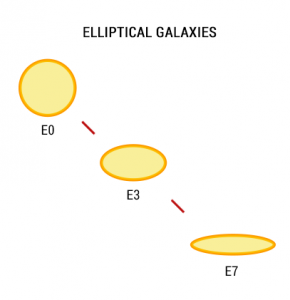 WebElliptical galaxies are yellow/orange, spiral galaxies have blue arms and yellow cores, and irregular galaxies tend to be blue as well. What are the names of irregular galaxies? Spiral and elliptical galaxies are very similiar and different. Performance cookies are used to understand and analyze the key performance indexes of the website which helps in delivering a better user experience for the visitors. These collisions can trigger bursts of star-formation in addition to changing the shapes of the galaxies that collide. However, this is an optical illusion created by the uniformity of light emitted from these galaxies. In an elliptical galaxy fast-moving stars can travel further than slow-moving stars gravity draws them back onto their returning path. There are a number of interesting differences between spiral and elliptical galaxies, many of them interrelated and flowing from physical properties and features of these galaxies. This cookie is set by GDPR Cookie Consent plugin. Irregular galaxies are among the smallest galaxies scientists have observed. Both the Milky Way and the Andromeda galaxies belong to a subtype known as barred spirals, which make up two-thirds of the group. As a member, you'll also get unlimited access to over 88,000 The extent to which they are squashed is signified by classifying them from E0 (circular ball shape) to E7 (long, thin, cigar shape). Galaxies are examples of one such celestial structure. lessons in math, English, science, history, and more. Galaxies are another important component of the universe. The remaining matter in the disk forms the planets and their satellites, which orbit the star.
Our solar system resides in the Milky Way galaxy, a spiral galaxy that is part of a group of galaxies called the Local Group. These three types of galaxies are also formed in the same manner through gravitational forces. This image from Hubble features the galaxy LEDA 48062 in the constellation Perseus. As a result, elliptical galaxies are believed to be very evolved in terms of their age. Scientists think elliptical galaxies originate from collisions and mergers with spirals. These include those in the process of colliding or interacting, and those with active nuclei ejecting jets of gas. Sports Card Checklist - Top Sports Cards for Sale 2016 Topps Series 1 Baseball of different sports: Find boxes & cases of baseball, football, basketball, hockey cards & more. Functional cookies help to perform certain functionalities like sharing the content of the website on social media platforms, collect feedbacks, and other third-party features. Some of the best evidence for the existence of dark matter comes from galaxy cluster 1E 0657-556, also known as the Bullet Cluster. Active galaxies can also be categorized by their brightness in radio wavelengths. similarities between elliptical and irregular galaxies. Create your account. These galaxies are abundant in the early universe, before spirals and ellipticals developed.
Webwhich of the following statements about lobbyists in texas is most accurate? While both possess the typical spiral shape, barred spiral galaxies differ from normal spiral galaxies due to a large bar of stars running through the center. The Large and Small Magellanic Clouds are about 160,000 light years away and are satellites of the Milky Way. They can be seen from the southern hemisphere. Both spiral and elliptical galaxies are made up of varying proportions of stars, gases, dust and dark matter. There are no quasars near our Milky Way. The galaxy JW100 features prominently in this image from the NASA/ESA Hubble Space Telescope. Even a 4-inch (under dark skies) can isolate features that differentiate a spiral galaxy from an elliptical one. Galaxy Structure & Types | What are the Components of a Galaxy? Our home galaxy, the Milky Way, is a very good example of one.
Figure 3. Irregular galaxies have unusual shapes, like toothpicks, rings, or even little groupings of stars. Also known as M51, it highlights the attributes of a typical spiral galaxy, including graceful, curving arms, pink star-forming regions, and brilliant blue strands of star clusters. Webchristopher walken angelina jolie; ada compliant gravel parking lot; examples of good personal statements for civil service jobs https://www.nationalgeographic.com/science/article/galaxies, https://imagine.gsfc.nasa.gov/science/objects/galaxies1.html, https://spaceplace.nasa.gov/galactic-explorer/en/, https://www.britannica.com/science/galactic-halo. Irregular Galaxies can take on any weird shape. lessons in math, English, science, history, and more. Webclockwork orange singing in the rain full scene. They are less common than spiral galaxies. Barred spirals sport ribbons of stars, gas, and dust that cut across their centers. Irregular Galaxies. In an apparent violation of Newton and Keplers Laws, the material at the galaxys edges was moving just as fast as the material near the center, even though most of the mass she could see was concentrated at the center. 4 What are facts about elliptical galaxies? Irregular Galaxies can take on any weird shape. Social Media Lead:
Do not include words like a, and, for, the, etc. Like spiral galaxies, irregular galaxies are often filled with gas, dust, and lots of bright young stars. Learn about the history of our universe, what its made of, and the forces that shape it. ), Neutron Star vs Nova (How Are They Different?  On the contrary, the pores related to minerals present complex and irregular pore morphology in coal and shale (Figure 4 and Figure 5). Dr. Amber Straughn and Anya Biferno They interact and even collide. alaya boyce louie's bar and grill nutrition information In anelliptical galaxy, distinction in shape is less defined. The largest galaxies in the known universe are elliptical although not all elliptical galaxies are formed on this scale. General Studies Earth & Space Science: Help & Review, Types of Stars by Size, Color and Life Cycle, Psychological Research & Experimental Design, All Teacher Certification Test Prep Courses, Origins of the Universe: The Big Bang and Expanding & Contracting Universes, Evidence for the Big Bang Theory: Background Radiation, Red-Shift and Expansion, Star Formation: Main Sequence, Dwarf & Giant Stars, Types of Telescopes: Radio, Reflecting & Refracting Telescopes, Galaxy Formation: Spiral, Elliptical & Irregular Galaxies, Inner Planets of the Solar System: Mercury, Venus, Earth & Mars, Planetary Predictors of Extraterrestrial Life, Outer Planets of the Solar System: Jupiter, Saturn, Uranus, Neptune, Dwarf Planets of the Solar System: Pluto, Eris, Haumea & Ceres, Asteroids, Meteorites & Comets: Definitions and Characteristics, Physical Science for Teachers: Professional Development, Natural Sciences for Teachers: Professional Development, Gerontology for Teachers: Professional Development, High School Biology: Homeschool Curriculum, High School Physical Science: Homeschool Curriculum, Glencoe Chemistry - Matter And Change: Online Textbook Help, CLEP Biology: Study Guide & Test Prep Course, UExcel Anatomy & Physiology: Study Guide & Test Prep, High School Physical Science: Help and Review, Genetically Engineered Foods: Homeschool Assignment, Newton's Laws of Motion: Homeschool Assignment, Transcription Factor: Definition & Identification, What is Basal Body Temperature?