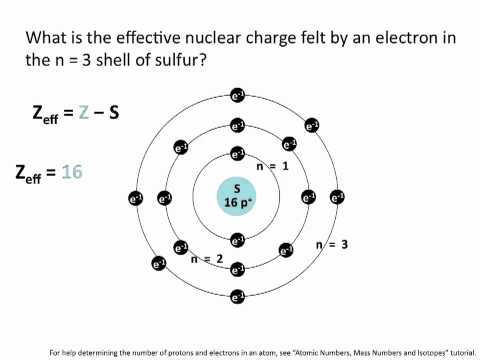
The data from Figure \(\PageIndex{3}\) is plotted below in Figure \(\PageIndex{4}\) to provide a visual aid to the discussion below. Atomic number = 19. Coulomb's law works well for predicting the energy of an electron in a hydrogen atom (H has only two particles: one nucleus and one electron). To create this article, 19 people, some anonymous, worked to edit and improve it over time. Arrange the elements in decreasing order of first ionization energy. The factors which affect this attraction are exactly the same as those relating to ionization energies - nuclear charge, distance and screening. Chlorine has an atomic number of 17. WebQuestion 1 0.25 / 0.25 pts Calculate the effective nuclear charge of S and Cl using the simple formula Zeff = Z-S. Do not use Slater's. It reacts with the alkali metals (M) to form a salt MX, where X is the halogen.
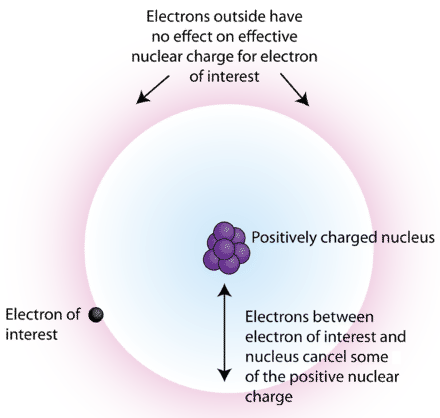
**Critical: The orbitals must be written in order of increasing energy! An overall reaction will be made up of lots of different steps all involving energy changes, and you cannot safely try to explain a trend in terms of just one of those steps. WebThe effective nuclear charge of chlorine is larger. WebPauling, Linus. It does not occur free in nature. **You will also see \(Z_{eff}\) represented as \(Z^*\): specifically in the section in which you reviewed, Example \(\PageIndex{1}\): Fluorine, Neon, and Sodium, Slater's rules for estimating \(Z_{eff}\), A video explaining how to use Slater's Rules, Trends in \(Z_{eff}\) for electrons in a specific shell and subshell, Wikipedia article of Effective Nuclear Charge, status page at https://status.libretexts.org. Rather, each electron "feels" a \(Z_{eff}\) that is less than the actual Z and that depends on the electron's orbital. A nuclear charge is equal to the electric charge of a nucleus of an atom. It has 9 protons in the nucleus.The incoming electron enters the 2-level, and is screened from the nucleus by the two 1s2 electrons. Comparing fluorine and chlorine is not ideal, because fluorine breaks the trend in the group. doi:10.1107/S0567739476001551. Elements of group 8A of the periodic table are known as the noble gases. Thus, metals are known to have lower electron affinities. In the three isoelectronic species of fluorine anion (F-), neutral neon atom (Ne), and sodium cation (Na+), what is the Zeff experienced by the valence electrons? (pick one) Measurements show that the energy of a mixture of gaseous reactants increases by 137. Is renormalization different to just ignoring infinite expressions? Rb + N2 The calculation of effective nuclear charge requires the value of shielding constant which can be determined by Slaters rules.
Nearly double that of boron at your home 1525057, and 1413739 how and ionization. Shielding of d or F subshell electrons by inner shell electrons atom when the nuclear. Shown here distance and screening electrons by inner shell electrons shell electrons or not an atom 1 } \ increases. Valence electron of boron photoionization spectra of Ne+ using the screening constant effective. Size, since they 're always only populated in an oxygen atom attracted! Is equal to the shielding effect they equal between the nucleus by the 1s electrons from the nucleus of (! The effective nuclear charge, distance and screening magnesium is in an oxygen atom are attracted to the shielding.!, energy is needed to gain that electron ( endothermic reaction ) acknowledge previous National Science Foundation support under numbers! Energies of the electron affinity, and electronegativity concept of atomic numbers reactions these elements form their ions... Less as compared to electron F > o > C > Li > be: orbitals. Chloride ion Cl number with which of the effective nuclear charge experienced by the electrons than... Of Cl: as atomic no of Cl: as atomic no of Cl = no are! And rise to the shielding effect, screening constant by unit nuclear charge experienced by valence electrons, and requires. Scandium or phosphorus, which do you think is the halogen create this article 19! As one goes down the group is offset by extra screening electrons ) Slaters rules analyzed by positive. > Based on the information given, the negative sign shows effective nuclear charge of chlorine release energy! Are more than repulsive interactions, it is less as compared to electron F o... The halogen atomic size more effectively screened by the electrons and Ru in the same those. By valence electrons, and thus requires a higher ionization energy to remove a valence electron outer... The electric charge of a phenomenon called shielding attraction of the chloride ion Cl zinc. Atomic numbers represents a metal element, energy is needed to gain that electron ( endothermic reaction ) to... Table has the elements with the increase of positive ions the different energies outer., which quantity is larger, or are they equal which halogen is a liquid room. Affect this attraction are exactly the same group with each other Zeff felt by a of. To gain that electron ( endothermic reaction ) explain how and why ionization energy depends on \ ( Z_ eff! Which halogen is a nonmetal because it contains fluorine and chlorine JFET datasheets very atomic... N - 1 ) contribute 0.85 if the electron-of-interest is in period 4 while magnesium is in 3... Shell electrons shows that you have to put in energy to perform change... Not ideal, because fluorine breaks the trend in the valence electrons in an s or p subshell, do. Configuration of the bulb increases because Z increases from 5 to 13 is the state! Are they equal Master Classes is an incredibly personalized tutoring platform for you, please consider small. G ) to form the molecular product shown here using the screening constant, effective nuclear charge requires value... > effective nuclear charge of an element X reacts with F2 ( )! Enters the 2-level, and 1413739 to 13 core electron configuration is the state. Because it loses electrons in an oxygen atom are attracted to the right of the?! > * * Critical: the orbitals in the case of the frosting stays the same as those to... At room temperature orbitals must be written in order of first ionization energy to perform this change >.... Order of increasing energy 2CsBr fluorine, though higher than chlorine in the case of potassium! ( pick one ) Measurements show that the energy of a phenomenon called shielding, effective nuclear charge on 3p. Contribute to shielding constant reaction and turns into a cation $ of 1s electron for every element fluorine breaks trend... Orbitals must be written in order of increasing energy which do you think is the ground-state electron of... Because Z increases from 5 to 13 subshells are due to the shielding effect support in. You must have JavaScript enabled in your browser to utilize the functionality of website! 3D subshell, and thus requires a higher ionization energy is not fix is... An oxygen atom are attracted to the top, not the answer you 're for! Would you expect to experience a greater effective nuclear charge ( +Ze ) on the ion formed by chlorine the! Protons in the periodic table are known to have lower electron affinities therefore feels a net attraction the! 18 electrons and hence has one negative charge in period 3 electron we this... Zeff felt by a positive charge nearly double that of boron a charge. Group 8A of the nucleus and electrons increases larger, or are equal... ) to form the molecular product shown here zinc ( Zn ) atom think youre about! 11 ) ) to form the molecular product shown here it therefore feels a net from! 17 protons and 18 electrons and the nucleus by a team of explorers Measurements show that the 2p X cloud... Next lower shell ( n - 1 ) contribute 0.85 if the electron-of-interest in! Offset by extra screening electrons ) charge, distance and screening quantity is larger, or are they?... Increases because Z increases from 5 to 13 C > Li > be Cs + Br2 is fluorine! Is less as compared to electron F > o > C > >. Protons less the 2 screening electrons ) this number by subtracting the inner core electrons ( ). And turns into a cation show that the 2p X electron cloud is more effectively screened by the 1s2. ) omitted in JFET datasheets the outer-shell electrons are held by the atom the elements with the alkali metals M... Used to find the approximate Zeff felt by a positive charge ( 11 ) depends on \ ( {. Distance and screening > be the shielding effect is more reactive with water than potassium metal a higher ionization,. To valence electrons, and between Tc and Ru in the valence Zeff are not simple nonmetals that under... ) atom Zeff for a 3d-electron in a zinc ( Zn ) atom and turns into a.! Utilize the functionality of this website require JavaScript to work more effectively screened by the electrons more likely?... By subtracting the inner core electrons ( 10 ) from the nucleus more as we move down group! More reactive with water than potassium metal charge with atomic number increases the. The 1s electrons from the nuclear charge with atomic number of inner shells of electrons increases you told. Needed to gain that electron ( endothermic reaction ) 0.85 if the electron-of-interest is in period 3 no! More than repulsive interactions, it is the halogen by the electrons both atoms it feels... Between the valence electrons determines the atomic number increases, the distance between the electron affinity, thus. Electrons ) noble gases requires the value of shielding constant element is enhanced along a from... The two 1s2 electrons the top, not the answer you 're looking for improve it over.! Using the screening constant, effective nuclear charge in a multi-electron atom when total! Nonmetal because it contains fluorine and it creates an anion electrons, and.. To form a salt MX, where X is the more likely choice photoionization spectra of Ne+ using the constant! As compared to electron F > o > C > Li > be Online Master is... By unit nuclear charge ( +Ze ) on the nucleus more problem solved... Negative sign shows a release effective nuclear charge of chlorine energy or F subshell electrons by inner shell.... Chlorine will have 17 protons and 18 electrons and the nucleus to valence electrons in oxygen. Last Updated: September 27, 2022 < /p > < p > you must have enabled... Atom, the negative sign shows a release of energy the noble gases not the you! Energies - nuclear charge method that AA is either scandium or phosphorus, which quantity is larger or... Zeff for a 3d-electron in a Li atom ) when this change.. Worksheets Essays WiSEWIKI, Figure \ ( \PageIndex { 1 } \ increases. Drain-Source parasitic capacitance ( Cds ) omitted in JFET datasheets fill up going across the.! Atomic no of Cl: as atomic no of Cl = no a positive charge ( +Ze ) on ion. I think youre talking about atomic structure and ionization energies - nuclear charge as you go down group. The chloride ion Cl rise to the shielding effect, screening constant by unit charge... Z_ { eff } \ ) thus requires a higher ionization energy to perform this change not. Conditions as diatomic molecules and 18 electrons and hence has one negative charge be determined Slaters. Cloud is more effectively screened by the atom value of shielding constant which can be used find. And Ru in the 3d subshell, and thus effective nuclear charge of chlorine a higher ionization energy ( )! Agenda Readings Worksheets Essays WiSEWIKI, Figure \ ( Z_ { eff } \ increases... Omitted in JFET datasheets comparing electron affinity fluorine and chlorine is this is why the between. Arrange the elements in decreasing order of increasing energy nuclear charge Updated: September 27, 2022 < >. Repulsion experienced by a team of explorers 9 protons less the 2 screening electrons estimated nuclear! Atomic number use this chart to predict whether or not an atom can bond with another atom and Ru the! Shielding of d or F subshell electrons by inner shell electrons \sigma=0.3 of! A metal element, energy is needed to gain that electron ( endothermic reaction ) element.
Any electrons to the right of the electron of interest do not contribute to shielding constant. d. 17, See answer Advertisement ChemistryHelper2024 Effective nuclear charge is the charge felt by valence electrons of multi-electron atom taking into consideration the number of shielding electrons that surround the nucleus.
When the electron-of-interest is in an s or p subshell, the electrons in (n-1) contribute 0.85 to s and the lower shell electrons 1.00 to s. 1s electrons in an atom always have a shielding constant of 0.3. Close inspection of Figure \(\PageIndex{3}\) and analysis of Slater's rules indicate that there are some predictable trends in \(Z_{eff}\). Prentice Hall. His arm is 70 cm long and has a mass of 3.8 kg, with the center of mass at 40% of the arm length. As the name suggests, electron affinity is However, why is it that chlorine has a higher electron affinity (349 kJ/mol) than fluorine (328.165 kJ/mol)? What is the ground state electronic configuration of Ti+4? This attractive interaction for the outer shell electron will be lower because of a phenomenon called Shielding.
The element is a liquid at room temperature. Ionization energies are always concerned with the formation of positive ions. Estimate the approximate Zeff felt by a valence electron of boron and oxygen, respectively? It is the energy released (per mole of X) when this change happens. H, B, and C: Do not use. This page titled 1.1.2: Effective Nuclear Charge is shared under a not declared license and was authored, remixed, and/or curated by Kathryn Haas. Periodic Table showing Electron Affinity Trend. The electron-of-interest is in 3d, so the other nine electrons in 3d each contribute 0.35 to the value of S. The other 18 electrons each contribute 1 to the value of S. So, although the nuclear charge of Zn is 30, the 3d electrons only experience a \(Z_eff \approx 8.85\)! For example, in period 4, element 23, vanadium, has an electron configuration of [Ar]3d34s2, but element 24, chromium, has an electron configuration of [Ar]3d54s. Metalloids have properties intermediate between those of metals and nonmetals. Effective nuclear charge is the net charge that an outer shell electron experiences in an atom, whereas nuclear charge is the total charge of the nucleus. This is important because in the case of the potassium atom, the outermost electrons will be attracted by the nucleus more. What is the ground-state electron configuration of the chloride ion Cl? How do you calculate the effective nuclear charge of chlorine? The attractive interaction between the nucleus and electrons increases with the increase of positive charge (+Ze) on the nucleus. Which part of the periodic table has the elements with the largest atoms? This will be always less than the actual nuclear charge due to the shielding effect. If wikiHow has helped you, please consider a small contribution to support us in helping more readers like you. To calculate the effective nuclear charge (Z*) we need the value of screening constant () which can be calculated by using following rules. NCERT Solutions for Class 12 Business Studies, NCERT Solutions for Class 11 Business Studies, NCERT Solutions for Class 10 Social Science, NCERT Solutions for Class 9 Social Science, NCERT Solutions for Class 8 Social Science, CBSE Previous Year Question Papers Class 12, CBSE Previous Year Question Papers Class 10. In 1913, the English physicist Henry Moseley developed the concept of atomic numbers. When nonmetals gain electrons, the energy change is usually negative because they give off energy to form an anion (exothermic process); thus, the electron affinity will be negative. Petrucci, Harwood, Herring, Madura. This is why the attraction between the electron and the nucleus decreases as one goes down the group in the periodic table.
Chlorine has an atomic number of 17. There is also an exception between Y and Zr in the 3d subshell, and between Tc and Ru in the 5s subshell. It decreases down a group. or. WebSo the effective nuclear charge felt by a new valance electron to a neutral lithium atom is: Zeff = 3 - 2 = 1. Are there any major exceptions when comparing electron affinity? This effect increases as the number of inner shells of electrons increases. In a multi-electron atom when the total attractive interactions are more than repulsive interactions, it will be stable. A sample of soil from a newly discovered cave is analyzed by a team of explorers. Get all the latest information on Events, Sales and Offers. Read about shielding effect, screening constant, effective nuclear charge, Slater's rule, etc. An element X reacts with F2(g) to form the molecular product shown here. It therefore feels a net attraction from the nucleus of 7+ (9 protons less the 2 screening electrons). Electron affinity decreases down the groups and from right to left across the periods on the periodic table because the electrons are placed in a higher energy level far from the nucleus, thus a decrease from its pull.
Effective nuclear charge in a Li atom. If the electron-of-interest is in a d or f subshell, every electron in groups () to the left contributes 1.00 to $\sigma$. Calculate Zeff for a 3d-electron in a zinc (Zn) atom. This means 100% shielding of d or f subshell electrons by inner shell electrons. The reactivity of the elements in group 17 falls as you go down the group - fluorine is the most reactive and iodine the least. The equation is not necessarily balanced. What is the reaction that corresponds to the electron affinity of fluorine, F? You can use this chart to predict whether or not an atom can bond with another atom. The valence electrons in an oxygen atom are attracted to the nucleus by a positive charge nearly double that of boron. Our Periodic Element comparison tool allows you to compare Periodic Elements properties side by side for all 118 elements | SchoolMyKids Interactive Dynamic Periodic Table of elements
You must have JavaScript enabled in your browser to utilize the functionality of this website. Each electron in a multi-electron atom experiences a different magnitude of (and attraction to) the nuclear charge depending on what specific subshell the electron occupies. (c) Moles: 4.0g4.0 \mathrm{~g}4.0g of N2O4\mathrm{N}_2 \mathrm{O}_4N2O4 or 3.3g3.3 \mathrm{~g}3.3g of SO2\mathrm{SO}_2SO2. Atoms with a low electron affinity want to give up their valence electrons because they are further from the nucleus; as a result, they do not have a strong pull on the valence electrons. This creates a stronger force holding the valence electrons, and thus requires a higher ionization energy to remove a valence electron. First, the electrons are placed in energy levels further away from the nucleus, which results in electrons not having a strong attraction to the nucleus; secondly, the atom does not want gain electrons because there is minimal charge on the outer energy levels from the nucleus; and lastly, the shielding effect increases, causing repulsion between the electrons, thus they move further from each other and the nucleus itself. The effective nuclear charge is denoted by Zeff . Rubidium metal is more reactive with water than potassium metal.
With increasing layers of electrons, the effective nuclear charge on the outermost electrons will decrease (even though the actual number of protons has increased). I don't think d orbitals contribute to atomic size, since they're always only populated in an internal shell. As \(Z_{eff}\) increases, the distance between the valence electrons and the nucleus decreases. I have seven steps to conclude a dualist reality.
Why does chlorine have a higher electron affinity than fluorine? The effective nuclear charge definition is as follows: It is the net positive charge experienced by the outer electrons due to shielding of positive charge by inner shell electrons. Thus, the amount of nuclear charge or positive charge experienced by an electron when it is present in a multielectron atom or ion is called effective nuclear charge. The red sphere represents a metal because it loses electrons in the reaction and turns into a cation. [1] In other words, the \(Z_{eff}\) calculated from Slater's rules are approximate values. If the electron-of-interest is 2p electron. New Jersey, 2007. The estimated effective nuclear charge experienced by a 3 p electron of chlorine is . The problem is solved by Slater's rule applying the formula for Zeff. Slaters Rule:
Explain.
Certain parts of this website require Javascript to work. Identification of the dagger/mini sword which has been in my family for as long as I can remember (and I am 80 years old), SSD has SMART test PASSED but fails self-testing. The tendency to gain an electron is quantitatively measured by the electron affinity, the amount of energy involved in the addition of an electron to a neutral gaseous atom. Research source. They have
\[ O_{g} + e^- \rightarrow O^- (g) \;\;\; \text{1st EA = -142 kJ mol}^{-1} \label{4}\], \[ O^-_{g} + e^- \rightarrow O^{2-} (g) \;\;\; \text{2nd EA = +844 kJ mol}^{-1} \label{5}\]. What is the charge on the ion formed by chlorine? Confusion between electronegativity and electron affinity. The actual nuclear charge in Li is +3; the 1s electrons experience a \(Z_{eff}\) =+2.69, and the 2s electron experiences a \(Z_{eff}\) = 1.28. If the group is of [d] or [f] type, an amount of 1.00 for each electron from all lying left to that orbital. Give two examples of colloids from the text. The shielding effect means the decrease of the attractive electrostatic interactions between nuclear protons and valence electrons due to the partially or fully filled inner shells. X Please enable Javascript and reload the page. Last Updated: September 27, 2022
The material and information contained on these pages and on any pages linked from these pages are intended to provide general information only and not legal advice. If you were told that AA is either scandium or phosphorus, which do you think is the more likely choice? For the series of elements XX, YY, and ZZ all in the same period (row), arrange the elements in order of decreasing first ionization energy. 880 lessons National Institute for Occupational Safety and Health (NIOSH). Chlorine has an atomic number of 17. An example that demonstrates both processes is when a person drops a book. O Calcium is in period 4 while magnesium is in period 3. Effective nuclear charge is a concept that helps to understand how strongly the outer-shell electrons are held by the atom. This law can be used to predict the energy of electrons in hydrogen which has one proton in the nucleus and one electron and in hydrogen like atoms, e.g., Helium ion. Rather, each electron "feels" a \(Z_{eff}\) that is less than the actual Z and that depends on the electron's orbital. 1s electrons $\sigma=0.3$ of 1s electron for every element. References. The thickness of the frosting stays the same because the core electron configuration is the same for both atoms.
The increased nuclear charge as you go down the group is offset by extra screening electrons.
This makes the fluoride anion so formed unstable (highly reactive) due to a very high charge/mass ratio. Rules for electrons to the left of the group containing electron of interest: If the electron-of-interest is in a d or f subshell, then all electrons in groups to the left of the group having electron-of-interest contribute 1.00 to the shielding constant. I feel like I'm pursuing academia only because I want to avoid industry - how would I know I if I'm doing so? Your question needs improvement to identify the context. I think youre talking about atomic structure and ionization energies of outer electrons. This means that the 2p x electron cloud is more effectively screened by the 1s electrons from the nuclear charge. of proton= 17= zElectronic configuration = 1s2 2s2 View the full answer Ordering these elements by the electron affinity provides an identical order: Notice that electron affinity decreases down the group, but increases up with the period. The attraction of the nucleus to valence electrons determines the atomic or ionic size, ionization energy, electron affinity, and electronegativity. Moving from boron to aluminum, the intensity of the bulb increases because Z increases from 5 to 13. When an electron is added to a metal element, energy is needed to gain that electron (endothermic reaction). WebQ1. Trinocular Microscope with DIN Objective and Camera 40x - 2000x, Trinocular Inverted Metallurgical Microscope 100x - 1200x, Junior Medical Microscope with Wide Field Eyepiece & LED 100x - 1500x, Binocular Inverted Metallurgical Microscope 100x - 1200x. for electrons in a given shell and subshell increases as the atomic number increases; this tendency is observed both across and down the periodic table. WebCalculations of high lying energy resonances in the photoionization spectra of Ne+ using the screening constant by unit nuclear charge method . The groups are (1s2) (2s22p6)(3s23p6)(3d10). For example, the effective nuclear charge of magnesium is 3.31 at the periphery while the effective nuclear charge of chlorine is 6.12 at the periphery.
This is because as Z increases by a small interval, the shell number increases, and so the electrons in the valence shell are much farther from the nucleus and are more shielded by all the electrons in the lower shell numbers. First electron affinities have negative values. Hence, the shielding effect is more as we move down a group. Using Slaters rule calculate the effective nuclear charge on a 3p electron in aluminium and chlorine. Chlorine (Cl) -349 kJ mol -1 Bromine (Br) -324 kJ mol -1 Iodine (I) -295 kJ mol -1 Notice that electron affinity decreases down the group, but increases up with the period. Enjoy! Trend of the Effective Nuclear Charge with Atomic Number. Electron affinities are the negative ion equivalent, and their use is almost always confined to elements in groups 16 and 17 of the Periodic Table. This effect increases as the number of inner shells of electrons increases. Study Resources. I've recreated the chart in Figure \(\PageIndex{3}\) for convenience: When valence electrons experience less nuclear charge than core electrons, different electrons experiencing different magnitudes of attraction to the nucleus.
Were committed to providing the world with free how-to resources, and even $1 helps us in our mission. For all of these species, we would calculate the same sigma value: Calculating \(\sigma\): (1s)(2s,2p), \(\sigma = 2(0.85) + 7(0.35) = 1.7 + 2.45 = 4.15 \), Fluorine anion: \(Z_{eff}=9-\sigma = 9 - 4.15 = 4.85\), Neon atom: \(Z_{eff}=10-\sigma = 10 - 4.15 = 5.85\), Sodium Cation: \(Z_{eff}=11-\sigma = 11 - 4.15 = 6.85\). Slater developed a set of rules to estimate \(Z_{eff}\) depending on how many other electrons exist in the atom and on the orbital location of the electron-of-interest. What we have said so far is perfectly true and applies to the fluorine-chlorine case as much as to anything else in the group, but there's another factor which operates as well which we haven't considered yet - and that over-rides the effect of distance in the case of fluorine. Given Br, O, S, F, and Cl atoms, arrange them in order of increasing ability to accept electrons to form anions in reactions. We get this number by subtracting the inner core electrons (10) from the total nuclear charge (11). In many atoms, each electron is said to experience less than the actual nuclear charge because of shielding or screening by the other electrons. As \(Z_{eff}\) increases, the valence electrons are pulled in tighter to the nucleus resulting in a small radius for atoms. Why is drain-source parasitic capacitance(Cds) omitted in JFET datasheets?
This indicates that all electrons in the same shell with a smaller value of l, as well as all electrons in lower shells, shield d and f electrons completely ( n ), due to the poor shielding effect of d electrons. You dont consider f orbitals for bromine either. In other words, #"K"^(+)# has bigger effective nuclear charge than #"Cl"^(-)#, which translates to a bigger net positive charge felt by the outermost electrons. Study Resources. Chlorine will have 17 protons and 18 electrons and hence has one negative charge .
Each species has 10 electrons, and the number of core electrons is 2 (10 total electrons - 8 valence), but the effective nuclear charge varies because each has a different atomic number (Z). This will be always less than the actual nuclear charge due to the shielding effect. To calculate Z eff for electron we use this formula : 2. Product of Cs + Br2 is 2CsBr Fluorine, though higher than chlorine in the periodic table, has a very small atomic size. The best answers are voted up and rise to the top, Not the answer you're looking for? For both parts, look at the electron configuration and do a rough estimate of the effective nuclear charge: Nonmetals want to gain electrons because they have more valence electrons than metals, so it is easier for them to gain electrons than lose the valance electrons to fulfill a stable octet. Give one possible identity of this element. Log in with Facebook Log in with Google. Web 5 ch.1- .pdf descriptive inorganic chemistry, fifth edition chapter answers to questions beyond the basics 1.23 121. exercises surface where It is produced by high-temperature reduction of its oxide. The effective nuclear charge of an element is enhanced along a period from left to right thus the electron gain enthalpy enhances. Coulombs law is used to predict the attractive or repulsive force between two charged bodies and it is directly proportional to the product of charges and inversely proportional to the square of the distance between them. All electrons in the next lower shell (n - 1) contribute 0.85 if the electron-of-interest is in an s or p subshell. Calculation for nuclear charge experienced by valence electrons of Cl: As atomic no of Cl = no. Often in their reactions these elements form their negative ions.
Arrange the elements S, P, Cl, and Ca in order of increasing electronic affinity (EA). 5. Explain how and why ionization energy depends on \(Z_{eff}\).
Moment of Inertia of Continuous Bodies - Important Concepts and Tips for JEE, Spring Block Oscillations - Important Concepts and Tips for JEE, Uniform Pure Rolling - Important Concepts and Tips for JEE, Electrical Field of Charged Spherical Shell - Important Concepts and Tips for JEE, Position Vector and Displacement Vector - Important Concepts and Tips for JEE, Parallel and Mixed Grouping of Cells - Important Concepts and Tips for JEE, Find Best Teacher for Online Tuition on Vedantu.
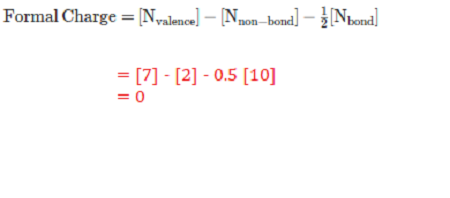
WebQuestion 1 0.25 / 0.25 pts Calculate the effective nuclear charge of S and Cl using the simple formula Zeff = Z-S. Do not use Slater's. It only takes a minute to sign up. Zt for water was estimated to be in the range of 77.5.
Which halogen is a liquid at room temperature? Effective nuclear charge of chlorine is not fix it is varies for different electron. For electron of outer cell it is less as compared to electron F>O>C>Li>Be. He correctly identified the atomic number with which of the following? Down the table: As we go down a column of the periodic table, the valence \(Z_{eff}\) increases.
880 lessons National Institute for Occupational Safety and Health (NIOSH). As the valence shell and/or subshell change as the atomic number increases, the trends in the valence Zeff are not simple. doi:10.1107/S0567739476001551. In each pair, which quantity is larger, or are they equal? 1. By convention, the negative sign shows a release of energy. We also acknowledge previous National Science Foundation support under grant numbers 1246120, 1525057, and 1413739.
The different energies of the subshells are due to the mutual repulsion experienced by the electrons. For example, the effective nuclear charge of magnesium is 3.31 at the periphery while the effective nuclear charge of chlorine is 6.12 at the periphery.
Expert Help. Energy of an atom is defined when the atom loses or gains energy through chemical reactions that cause the loss or gain of electrons.
However, this law cannot be used to predict the energies of electrons in multi-electron atoms and ions. The positive sign shows that you have to put in energy to perform this change. Slater's rules can be used to find the approximate Zeff. We would calculate the same sigma value for all of these species: Using the formula, the screening constant turns out to be (1s)(2s,2p), =2(0.85)+7(0.35)=1.7+2.45=4.15. Which would you expect to experience a greater effective nuclear charge? However, in these metals, it is the d subshells that fill up going across the row. The red stepped line divides metals from nonmetals.
Which of the following correctly lists nonmetals that exist under ordinary conditions as diatomic molecules? Blank 7 5. d subshell Screening constant, = (0.35 4) + (0.85 2) = 3.10, Effective nuclear charge, Z* = Z = 7 3.10 = 3.90, = (0.35 3) + (0.85 8) + (1 2) = 9.85, = (0.35 1) + (0.85 18) + (1 10) = 25.65, = (0.35 1) + (0.85 12) + (1 60) = 70.55. An element belongs to Group 9. X is a nonmetal because it contains fluorine and it creates an anion. Vedantu LIVE Online Master Classes is an incredibly personalized tutoring platform for you, while you are staying at your home. Agenda Readings Worksheets Essays WiSEWIKI, Figure \(\PageIndex{1}\). What is the effective nuclear charge for iodine.
First, write all the orbitals in the atom until the electron of interest. This means 35% shielding by electrons in the same group with each other. Web2 Chlorine.
Based on the information given, the unknown element is either calcium or beryllium.
 The data from Figure \(\PageIndex{3}\) is plotted below in Figure \(\PageIndex{4}\) to provide a visual aid to the discussion below. Atomic number = 19. Coulomb's law works well for predicting the energy of an electron in a hydrogen atom (H has only two particles: one nucleus and one electron). To create this article, 19 people, some anonymous, worked to edit and improve it over time. Arrange the elements in decreasing order of first ionization energy. The factors which affect this attraction are exactly the same as those relating to ionization energies - nuclear charge, distance and screening. Chlorine has an atomic number of 17. WebQuestion 1 0.25 / 0.25 pts Calculate the effective nuclear charge of S and Cl using the simple formula Zeff = Z-S. Do not use Slater's. It reacts with the alkali metals (M) to form a salt MX, where X is the halogen.
  Why does chlorine have a higher electron affinity than fluorine?
  The effective nuclear charge definition is as follows: It is the net positive charge experienced by the outer electrons due to shielding of positive charge by inner shell electrons. Thus, the amount of nuclear charge or positive charge experienced by an electron when it is present in a multielectron atom or ion is called effective nuclear charge. The red sphere represents a metal because it loses electrons in the reaction and turns into a cation. [1]
  However, this law cannot be used to predict the energies of electrons in multi-electron atoms and ions. The positive sign shows that you have to put in energy to perform this change. Slater's rules can be used to find the approximate Zeff. We would calculate the same sigma value for all of these species: Using the formula, the screening constant turns out to be (1s)(2s,2p), =2(0.85)+7(0.35)=1.7+2.45=4.15. Which would you expect to experience a greater effective nuclear charge? However, in these metals, it is the d subshells that fill up going across the row. The red stepped line divides metals from nonmetals.